Shibuya Sky vs Tokyo Skytree: Which Tokyo Deck Wins? (2026)
One tower is 121 metres taller. The other puts you on an open roof 229 metres above the busiest pedestrian crossing on earth. That single trade settles most versions of this argument.
 By Mia Nakamura, licensed Tokyo tour guide based in Shibuya
Short answer
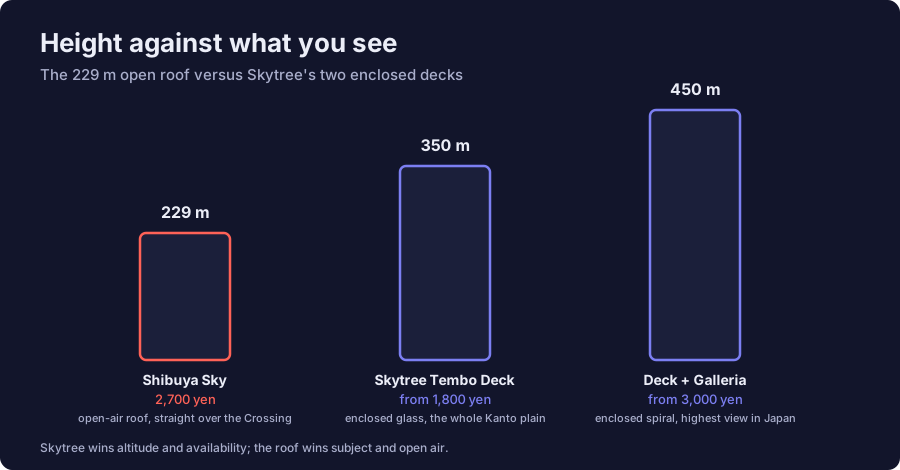
Tokyo Skytree wins on height and availability: 350 metres enclosed, 450 at the Galleria, from about 1,800 yen online, with same-week slots most weeks. SHIBUYA SKY wins on subject and open air, a 229-metre rooftop directly over the Scramble Crossing at 2,700 yen online before 15:00, released only 14 days ahead. First-time visitors usually pick the rooftop.
Two Towers, One Honest Split
Skytree wins height and easy booking; the Shibuya roof wins the subject and the open air. Check the one you are leaning toward before the 14-day window decides for you.
The question turns up on nearly every walk I lead through Shibuya, usually while we are waiting out a red light near the Hachiko exit. Skytree or here? People ask it as though one of the two has to be a mistake, and it is not that kind of choice. Skytree stands 350 metres up at its main deck and 450 at the Galleria. The Shibuya rooftop tops out at 229. The shorter one still wins for most first-time visitors, and the reason has nothing to do with altitude.
What decides it is subject and air. A deck is not a number, it is a thing you look at through something, or through nothing at all. Skytree looks at the whole Kanto plain from behind glass. SHIBUYA SKY looks straight down at the Scramble Crossing with the sky open above your head. Once you frame it that way, most travelers know within a sentence which one they want, and the rest of this page is about the details that turn the decision from a guess into a plan.
Which is better, Tokyo Skytree or Shibuya Sky?
Skytree is better if you want maximum height, guaranteed weather and easy tickets: 350 metres enclosed, 450 at the Galleria, from about 1,800 yen. Shibuya Sky is better if you want the open roof and the Crossing directly below, at 2,700 yen online before 15:00. Most first-time visitors prefer Shibuya Sky.
Height is the argument Skytree wins outright and the argument that matters least. Above roughly 300 metres, central Tokyo becomes a map rather than a place: the streets read as pattern, and the people vanish. That is genuinely impressive the first time, and it is also the same impression you get from an aircraft window. The Shibuya rooftop is low enough that the city stays legible. You can watch a specific crowd assemble at a specific curb, watch it release, and watch the intersection empty and refill roughly every two minutes.
The second difference is the glass. Skytree's two viewing levels are enclosed on every side, which is why they never close for weather and why night photographs from them carry reflections. SHIBUYA SKY's top level, the Sky Stage, is an open rooftop. Wind reaches you. Rain reaches you too, which is why the roof shuts without notice in storms and visitors are held on the indoor 46F Sky Gallery instead.
Then there is the practical wall. Shibuya Sky sells online exactly 14 days ahead at midnight Japan time, and the sunset windows disappear within minutes on most dates, while its doors stay open from 10:00 to 22:30 with last entry at 21:20 according to Tokyo's official tourism listing. Skytree has no such release cliff and far more capacity across two decks, so a slot in the next few days is usually still there. If you are deciding tonight for tomorrow, that alone answers the question, and if you have two weeks of runway you can compare every way to buy Shibuya Sky Tickets before the window opens.
| SHIBUYA SKY | Tokyo Skytree | |
|---|---|---|
| Highest viewing level | 229 m, open rooftop | 350 m Tembo Deck, 450 m Tembo Galleria |
| Enclosure | Open air on the roof, glass on the indoor 46F gallery | Glass on both levels |
| Adult online price | 2,700 yen before 15:00, 3,400 yen from 15:00 | Deck from about 1,800 yen, Deck plus Galleria from about 3,000 |
| When tickets appear | Exactly 14 days ahead, 00:00 Japan time | Well ahead of the date, no short release window |
| Opening hours | 10:00 to 22:30, last entry 21:20 | Varies by season, roughly 9:00 or 10:00 until 20:30 or 22:30 |
| Directly underneath | Shibuya Scramble Crossing and the station roof | The Sumida river, Asakusa, Oshiage |
| Weather risk | Rooftop closes in wind, rain, lightning or extreme heat | None, though haze flattens the distance |
| Getting there | Inside Shibuya Station's own building | Tokyo Skytree or Oshiage station |
How much does the extra height actually buy you?
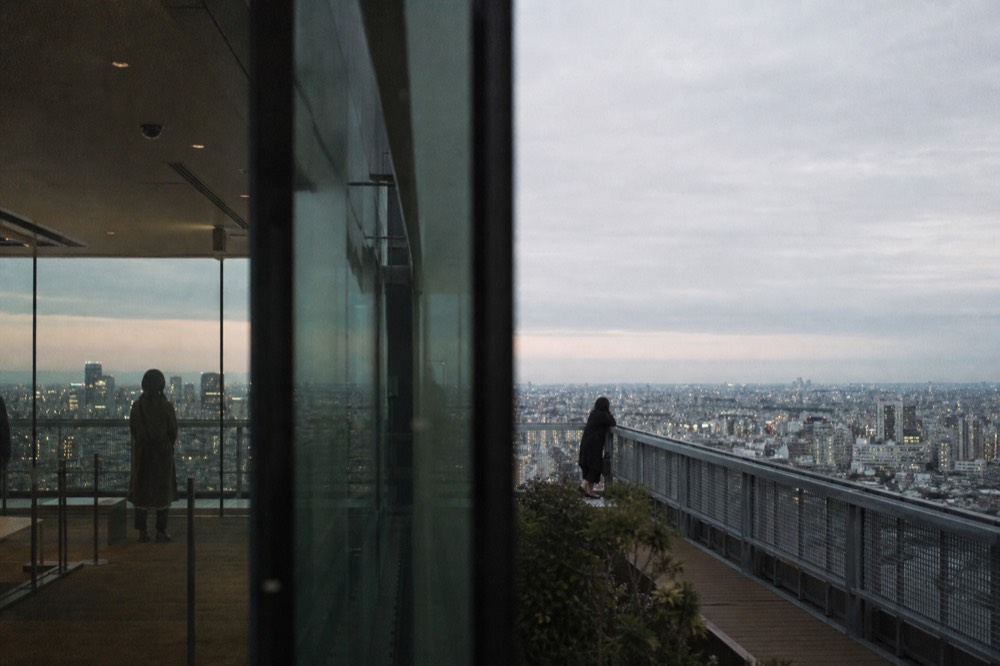
The Tembo Deck sits 121 metres above the Shibuya rooftop and the Galleria 221 metres above it. What that buys is horizon, not detail. Ground-level activity stops being readable somewhere around 300 metres, so the taller tower trades the city's texture for its geography.
I find it useful to think about what you can still identify from each level. At 229 metres, a crowd is a crowd: you see umbrellas separate, you see the diagonal walkers cut across the intersection, you can pick out the specific van stuck at the light. At 350 metres, the intersection nearest you is a bright smudge and the interest moves outward, to the river system, the bay, the ridgelines. At 450 metres you are above almost everything built in Japan, and the payoff is entirely about distance.
There is a reason so many people describe the Galleria as the least memorable part of a Skytree visit despite being the highest. It is a sloping glass corridor that spirals upward, and the view from it differs from the deck 100 metres below in ways that are hard to feel. The deck has the famous glass floor panel, the restaurant level and the sense of arrival. The Galleria has 100 more metres and a price step.
None of that makes the height pointless. If your interest is Tokyo as a system, the size of it, how the wards run into each other and where the water sits, the taller tower shows you something the Shibuya roof never can. Travelers chasing that specific feeling should read the honest verdict on whether the Skytree earns its ticket before they buy the combo tier rather than after, and can check the current Tembo Deck ticket here when they are ready, a separate booking from anything else on this page.
| Viewing level | Height | What still reads clearly | What the level is really for |
|---|---|---|---|
| Sky Gallery, indoor 46F | one floor under the roof | The crossing, the station lines, near towers | Shelter, the bar, digital art, the warm-up |
| Sky Stage, rooftop | 229 m | Individual people, single vehicles, crowd rhythm | The city as a living street pattern |
| Tembo Deck | 350 m | Blocks, rivers, rail corridors, bridges | The city as geography |
| Tembo Galleria | 450 m | Coastline, distant ranges, weather systems | Distance and the record height |
What does each deck actually look at?
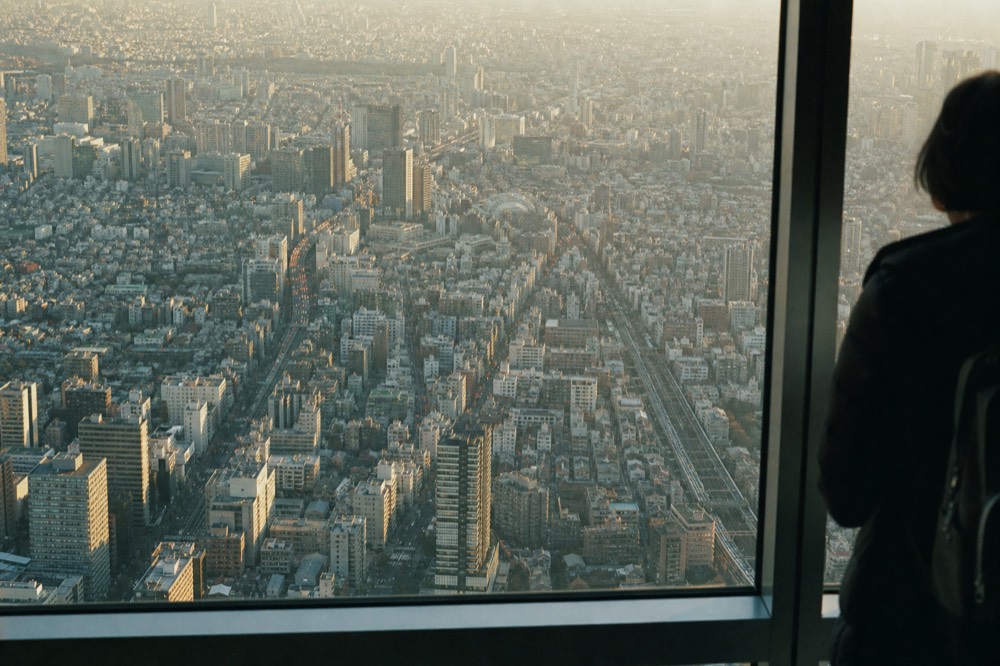
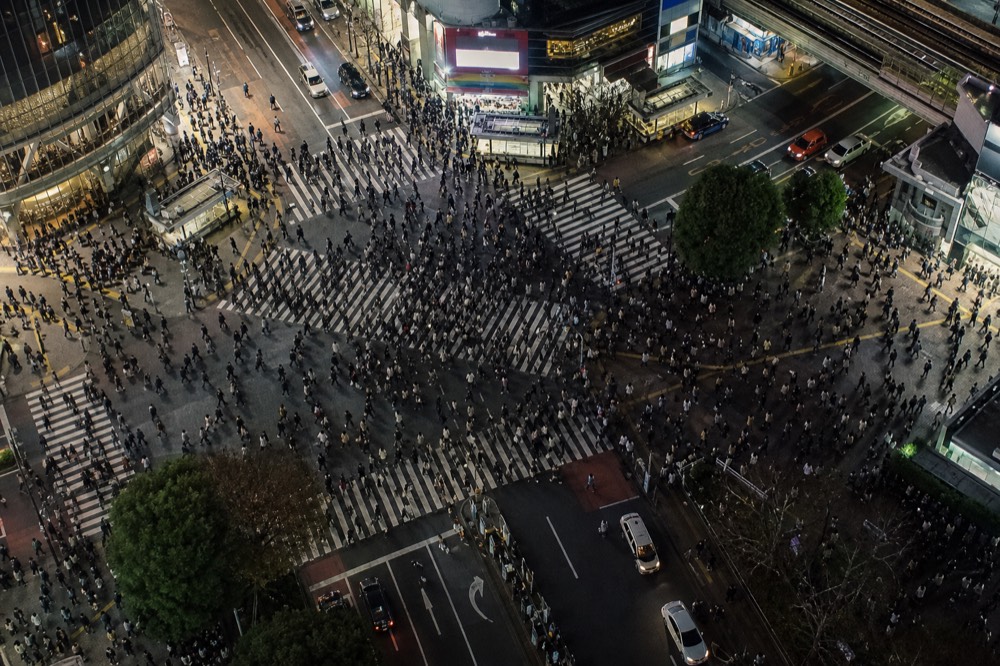
Shibuya Sky's subject is one intersection and the district around it, seen from almost directly overhead. Skytree's subject is the eastern half of the Kanto plain, with the Sumida river below and central Tokyo compressed into a distant band. Both see Tokyo Tower, the bay and, on clear days, Mount Fuji.
Stand at the Sky Edge corner of the Shibuya rooftop and the Scramble Crossing is beneath you at an angle that no other public viewpoint in the city offers. Traffic counts here are genuinely large: as many as 3,000 people cross on a single green light at peak, and a flow survey run in 2014 measured roughly 260,000 pedestrians on a weekday and about 390,000 on a non-working day. From 229 metres those numbers stop being statistics and turn into a pulse you can time.
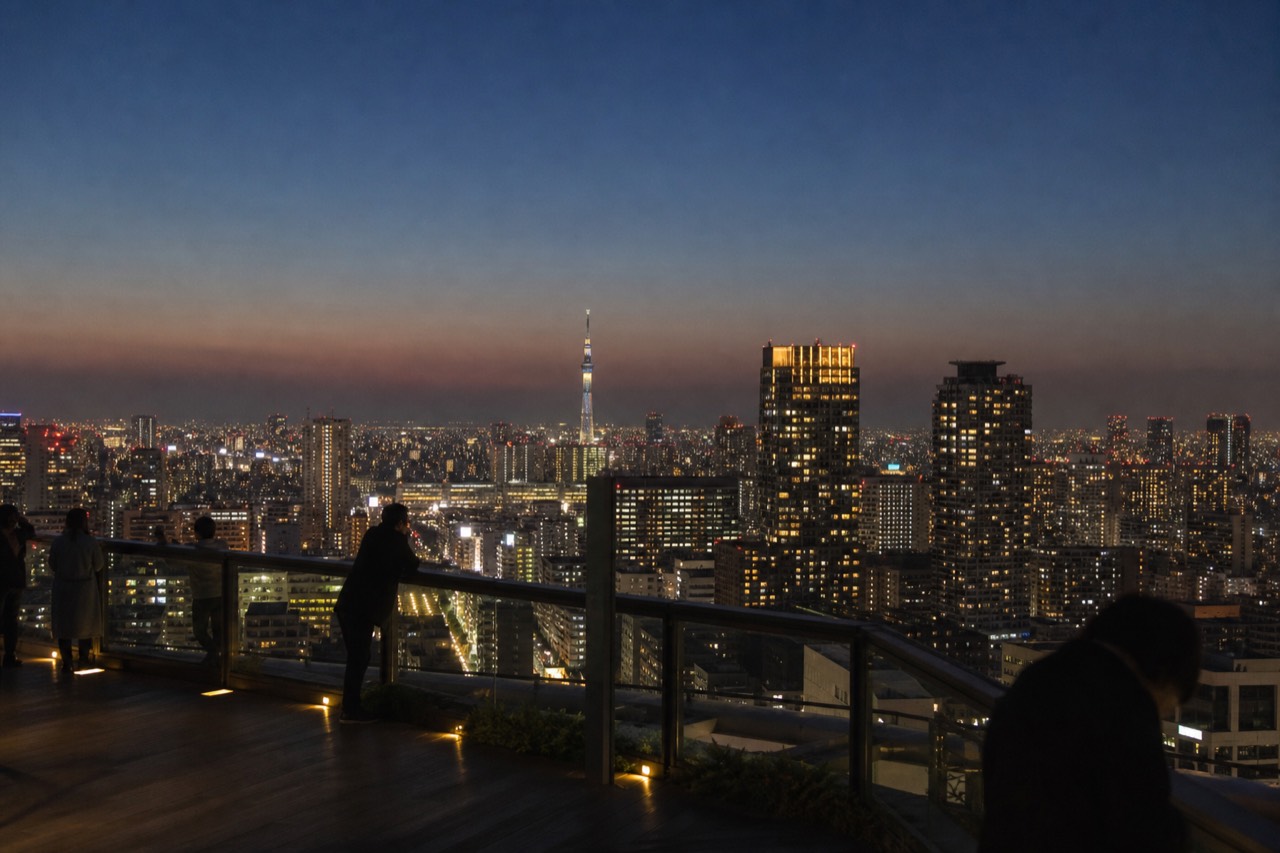
The rest of the Shibuya panorama earns less attention than it deserves. Shinjuku's tower cluster sits north with Yoyogi Park's green mass in front of it. Tokyo Tower and the Roppongi high-rises hold the east, with Skytree itself thin on the skyline behind them. West is the open direction, over the low western suburbs toward the hills, and that is where Fuji appears when the air is right.
Skytree flips the whole arrangement. The near ground is old low-rise Tokyo, Asakusa's temple roofs and the tight streets of the eastern wards, with the Sumida threading through. Central Tokyo becomes a wall of towers on the far side, and Tokyo Tower, which is 150 metres tall at its main deck, sits well below your eye line. After dark that reverses the mood entirely: the Shibuya roof gives you a lit intersection in motion, while Skytree gives you a still carpet of light with a dark river cut through it.
There is one asymmetry in all of this that nobody mentions on the tourist pages. From the Shibuya rooftop you can see Skytree, thin and distinctive on the eastern skyline, so the taller tower becomes part of your photograph. From Skytree you cannot really pick Shibuya out at all. It dissolves into the general mass of central Tokyo about twelve kilometres away, one bright patch among many. The lower deck contains the higher one visually, and the higher one does not return the favour.
What do the two decks cost, tier by tier?
Shibuya Sky charges 2,700 yen online for entry before 15:00 and 3,400 yen from 15:00 onward, with the 14F counter 300 yen dearer in each band. Skytree's Tembo Deck starts around 1,800 yen online and the 450-metre combo around 3,000, with counter prices roughly 500 yen above online.
The pricing logic differs in a way that catches people out. Skytree charges you for altitude: pay more, go higher. Shibuya Sky charges you for time of day, because sunset and the hour after it are what everyone wants. Crossing that 15:00 line costs 700 yen, and the deck does not care whether you stay ten minutes or two hours afterward.
Children work differently again, and this is the single most common booking mistake I see families make. The elementary-age ticket at Shibuya Sky costs 1,200 yen and is sold at the 14F counter only, never online. Age six and under enters free. So a family booking online buys adult tickets in advance, then queues briefly at the counter on the day for the child. Plan for it and it is a two-minute step. Discover it at the gate and it feels like a fault.
One more line worth knowing before you compare headline prices. THE ROOF, the seasonal bar on the Shibuya rooftop, runs from April 29 to December 25 this year with drink-set tickets from 7,000 yen and a strict age limit of 20 and over. That is a separate product from admission, not an upgrade to it, and the full breakdown of what every deck tier costs keeps the two apart. If you are simply after standard entry, you can check dates and the current price against the official web shop figures below.
| Ticket | Where you buy it | Adult price |
|---|---|---|
| Shibuya Sky, entry before 15:00 | Official web shop | 2,700 yen |
| Shibuya Sky, entry 15:00 or later | Official web shop | 3,400 yen |
| Shibuya Sky, entry before 15:00 | 14F counter | 3,000 yen |
| Shibuya Sky, entry 15:00 or later | 14F counter | 3,700 yen |
| Shibuya Sky, elementary-age child | 14F counter only | 1,200 yen |
| Shibuya Sky, age six and under | No ticket needed | Free |
| Skytree Tembo Deck, 350 m | Advance online | From about 1,800 yen |
| Skytree Deck plus Galleria, 450 m | Advance online | From about 3,000 yen |
| Skytree Galleria added at the tower | On the day | About 1,400 yen extra |
| Skytree, any tier at the counter | On the day | About 500 yen above online |
Which one is harder to book?
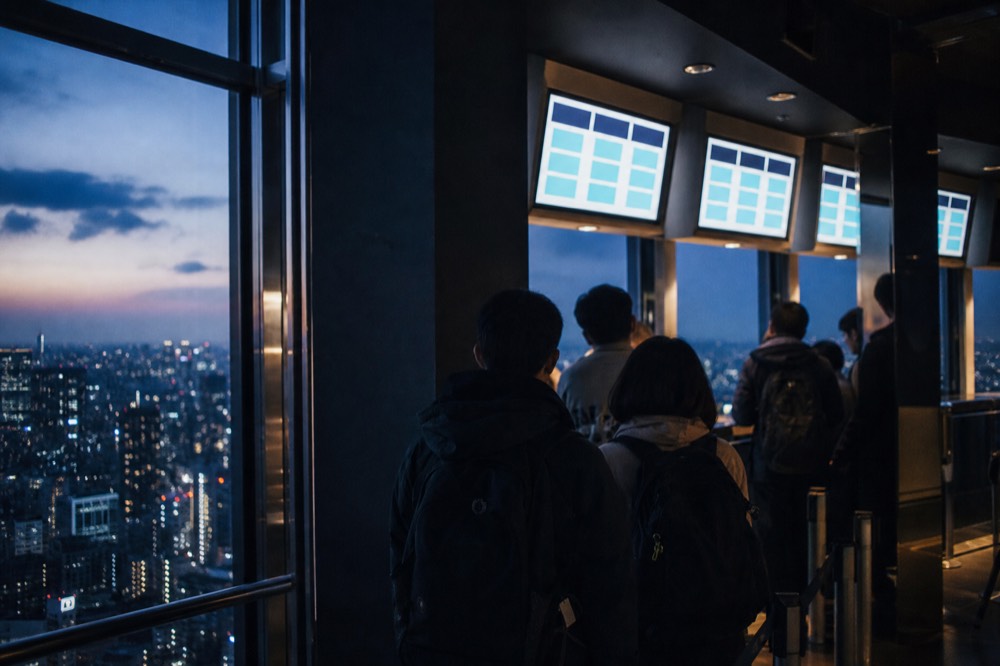
Shibuya Sky is far harder. Its online allocation opens exactly 14 days ahead at midnight Japan time and the sunset slots clear within minutes on most dates. When a date sells out online, the 14F counter has nothing left either. Skytree runs no equivalent cliff and usually has same-week availability.
The 14-day rule is the thing to understand, because it is unlike most Tokyo attractions. There is no six-month advance sale and no waitlist. A date simply does not exist for booking until two weeks before it, then it exists and starts draining. Slots from about an hour before sunset onward are the first to go, and on peak dates in the cherry blossom and autumn weeks they can be gone before breakfast in Europe.
That structure has a hard consequence people miss: the counter is not a fallback. Counter tickets come out of the same allocation, so if the web shop shows a date fully sold, turning up in person achieves nothing. Official web-shop tickets are also non-refundable and cannot be moved to another date or time, so the 14-day decision is a real commitment rather than a placeholder.
Skytree's advantage here is structural. Two decks, a much larger footprint and no artificial release window mean the tower absorbs demand that would sink a single rooftop. Set against that, its counter charges roughly 500 yen more than booking ahead, which is the price of deciding late. For anyone who wants the rooftop and cannot face the midnight alarm, guided options that bundle timed entry sit on the page of visits that include rooftop admission, and the mechanics of the release are set out step by step in the guide to the 14-day window.
| Booking factor | SHIBUYA SKY | Tokyo Skytree |
|---|---|---|
| Release window | Exactly 14 days ahead, 00:00 Japan time | No short release window |
| First slots to sell | The hour before sunset and the two after | Peak holiday afternoons only |
| If online is sold out | The 14F counter has nothing either | Counter tickets usually remain |
| Counter premium | 300 yen above the web shop | About 500 yen above online |
| Changes and refunds | Non-refundable, no date or time change | Set out on the official ticket page |
| Weather cancellation | Rooftop can close, refund only before entry | Runs in any weather |
| How far ahead to decide | Two weeks, with an alarm set | Often the same morning |
Open roof or glass wall: what changes on the deck?
Everything about how the visit feels. Shibuya Sky's rooftop bans bags, hats, tripods, selfie sticks, food, drink and earphones, and gives you unglazed air in return. Skytree keeps you behind glass on both levels with no rooftop rules to follow, and never closes for weather.
The rules on the Shibuya roof read as strict until you stand up there and understand them. At 229 metres in an open space with wind, anything loose becomes a projectile aimed at the busiest crossing in the world. So bags of every size go into the 100-yen coin-return lockers on 46F, hats come off, and phones or neck-strap cameras are the only things you carry. Suitcases go into station lockers downstairs before you ever reach the gate.
What you buy with that inconvenience is the absence of a pane. Photographs from the roof have no reflections, no double images of the ceiling lights, no colour cast. Blue hour looks the way your eye saw it. That is the whole case for the shorter tower in one sentence, and it is why photographers who have done both usually pick Shibuya, a point covered properly in what the rooftop is actually like.
Skytree's glass has its own quiet advantages, and they are not only about rain. Enclosed decks stay comfortable in February and in August, they let you linger without wind fatigue, and they carry a cafe and a restaurant so a visit can stretch into a meal. The trade shows up after dark, when interior lighting bounces off the glass and every phone photo picks up a ghost of the room behind you.
| On the deck | SHIBUYA SKY rooftop | Skytree Tembo Deck and Galleria |
|---|---|---|
| Air | Open to the sky, wind and temperature reach you | Enclosed and climate controlled |
| Bags | None of any size, lockers on 46F | Carried with you |
| Hats, tripods, selfie sticks | Not permitted on the roof | No rooftop, so the rule does not apply |
| Food, drink, earphones | Not permitted on the roof | Cafe and restaurant on the deck levels |
| Cameras | Phones and neck-strap cameras only, no glass in the frame | Any camera, shooting through glass |
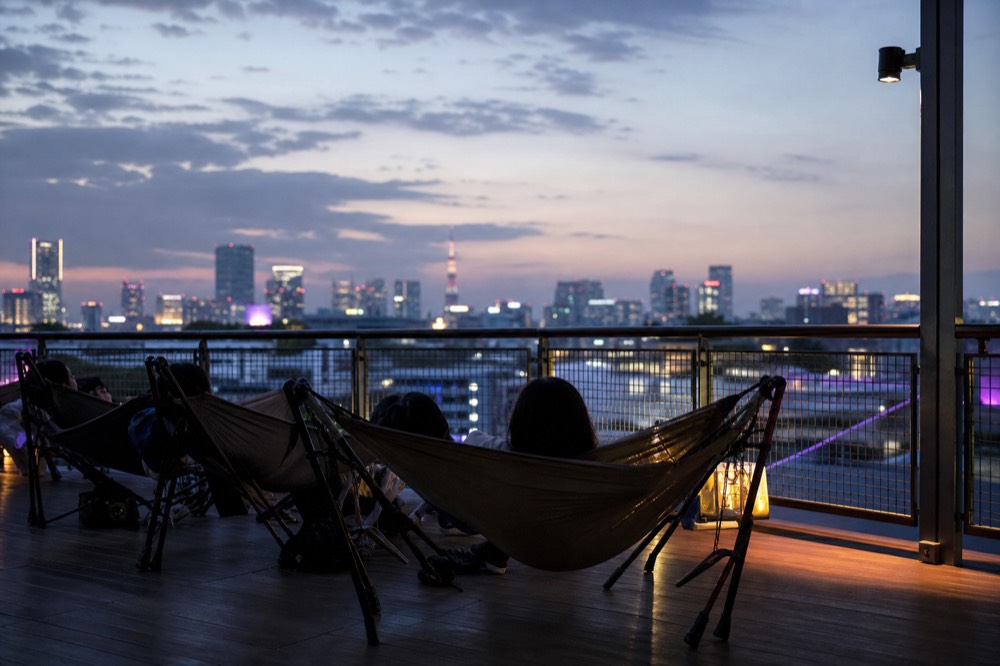
| Signature feature | Sky Edge corner, Cloud Hammocks, the Crossing Light show at night | The glass floor panel and the spiral walkway to 450 m |
| Bad weather | Closes without notice, indoor gallery only | Open regardless, haze permitting |
Which deck gives you the better chance of Mount Fuji?
On a genuinely clear day both show it, and Skytree's extra height helps at the margins. What decides it is air, not altitude: Fuji stands about 100 kilometres southwest and disappears into summer haze from either tower. Winter mornings and the hour after a cold front are the reliable windows.
Fuji is a 3,776-metre volcano, and at that distance it clears the horizon comfortably from any deck in Tokyo. The limiting factor is what sits in the 100 kilometres of air between. From June through September, humidity and heat haze routinely erase it entirely, whatever the forecast says about sunshine. From November through February the same view opens up on a majority of clear mornings.
Where the two towers really differ is in framing. Shibuya's rooftop faces west across low suburbs, so Fuji rises from a relatively uncluttered horizon and sits in the same frame as the sunset. From Skytree you are looking past the entire built mass of Tokyo to reach it, which is a striking composition of its own but puts far more city air in the line of sight. Add the open roof advantage and the Shibuya version photographs better even though it is lower.
Timing beats both. The mountain shows most often in the first hour after opening on a winter morning and again immediately after a cold front has scrubbed the air. Sunset visits catch it silhouetted rather than lit, which many people prefer and some find disappointing. The seasonal pattern, including which months are close to hopeless, is broken down in when Fuji actually shows from Tokyo, and if a west-facing evening is the goal you can see which sunset slots are still open on a guided entry that cancels free up to 24 hours out.
How long does each take from where you are staying?
Shibuya Sky needs no journey at all if you are in Shibuya: the gate is on the 14th floor of the building above the station. Skytree sits on the far eastern side of the city, about 35 minutes from Shibuya on a direct Hanzomon Line train and one stop from Asakusa.
The geography is not symmetrical, and it matters more than most itineraries allow for. Shibuya is a hub that half of Tokyo passes through anyway, so adding the rooftop to a day costs you the ascent and nothing else. Skytree is a destination, and reaching it usually means committing an afternoon or pairing it with Asakusa, which is the natural combination and a genuinely good one.
That pairing is the honest argument for Skytree that has nothing to do with the view. Senso-ji, Nakamise street and the old Asakusa lanes sit a single Tobu stop away, or a twenty-minute walk along the river. If your day already lives on that side of town, the tower stops being a detour. If your day lives in Shibuya, Harajuku or Shinjuku, crossing the city for a taller deck is an hour of train time you could have spent in the district.
| Starting point | To SHIBUYA SKY | To Tokyo Skytree |
|---|---|---|
| Shibuya Station | You are in the building, gate on 14F | Hanzomon Line direct to Oshiage, about 35 min |
| Shinjuku | Two stops on the Yamanote, about 7 min | About 40 min with one change |
| Asakusa | Ginza Line straight through, about 30 min | One stop on the Tobu line, or a 20 min walk |
| Tokyo Station | About 25 min | About 20 min |
| Ginza | About 15 min | About 25 min |
Which one should you pick?
First trips, photographers and anyone chasing the Crossing should take Shibuya Sky and accept the 14-day booking discipline. Families with small children, rainy days, late decisions and repeat visitors who have already done Shibuya are better served by Skytree, at a lower entry price.
The commonest good answer is not a single deck at all. Travelers with a week in Tokyo often do both and rate them separately: Shibuya for an evening, Skytree paired with an Asakusa morning. At roughly 2,700 and 1,800 yen respectively that is under 5,000 yen for two completely different readings of the same city, which is cheap for what it teaches you about how Tokyo is arranged.
If it has to be one, weigh the failure modes rather than the features. Shibuya Sky's failure mode is a closed roof on a windy evening and a non-refundable ticket. Skytree's failure mode is a hazy afternoon that turns 450 metres into grey soup with a glass reflection in the middle of every photograph. Neither risk is small, and only one of them can be checked the same morning. Travelers who already know which evening they want should see what is left in the next two weeks rather than wait, since nothing new is released after the window opens.
The wider field is worth a look before you commit either way, because two of Tokyo's best decks are not in this argument at all: the free 202-metre observatory in Shinjuku and the 251-metre Ikebukuro deck at 700 yen. All of them are set side by side in the full roundup of Tokyo's observation decks, and the official pages for Shibuya Sky and Skytree ticket tiers carry the current schedules if a date is close.
| Traveler | The pick | Why | What you give up |
|---|---|---|---|
| First trip, one deck only | SHIBUYA SKY | The Crossing from overhead is the image you came for | You must book 14 days out and cannot change it |
| Photographer | SHIBUYA SKY | No glass, no reflections, open sky at blue hour | No tripods, no bags, phones and neck-strap cameras only |
| Family with young children | Tokyo Skytree | Enclosed, no bag rules, book the same week | The child rate at Shibuya Sky is counter-only anyway |
| Repeat visitor to Tokyo | Tokyo Skytree | 450 metres shows a different geography entirely | The intersection you already know from above |
| Rain, wind or a typhoon fringe | Tokyo Skytree | The Shibuya roof closes without notice | The open air that makes Shibuya worth it |
| Sunset chaser | SHIBUYA SKY | West-facing open roof with Fuji in the same frame | 700 yen more from 15:00, and the fastest sell-outs |
| Tight budget | Skytree Tembo Deck | About 1,800 yen for the highest deck in Japan | The Crossing, and the open air |
Frequently asked questions
Is Shibuya Sky or Skytree better for photos?
Shibuya Sky, for one reason: the rooftop has no glass. Every Skytree photograph is shot through a pane, which shows up badly after dark as reflections of the interior lighting. The trade is equipment. The Shibuya roof allows phones and neck-strap cameras only, with no tripods, no bags and no selfie sticks anywhere on the open level.
Can you do both Shibuya Sky and Tokyo Skytree in one day?
Yes, and the sensible order is Skytree in the morning with Asakusa, then Shibuya for sunset. Allow about 35 minutes between them on a direct Hanzomon Line train. Book the Shibuya slot 14 days ahead, because that is the half of the plan that can sell out, and keep Skytree flexible.
Which deck is cheaper, Shibuya Sky or Skytree?
Skytree's Tembo Deck at around 1,800 yen online is the cheaper entry. Shibuya Sky costs 2,700 yen online before 15:00 and 3,400 from 15:00 onward. Once you add Skytree's 450-metre Galleria the combo starts around 3,000 yen, which lands between the two Shibuya time bands.
Does Shibuya Sky close if the weather is bad?
The open rooftop does. Wind, rain, lightning and extreme heat all close the Sky Stage without notice, and visitors are held on the indoor 46F gallery instead. Refunds are only possible before you enter, so check conditions before you pass the gate. Skytree's enclosed decks run in any weather.
Can you see Mount Fuji from Tokyo Skytree?
On clear days, yes, though you are looking past the whole city to reach it. Fuji stands about 100 kilometres southwest, so haze decides everything. Winter mornings and the hours after a cold front are the reliable windows at either tower, while June through September often erases the mountain completely.
How far ahead should I book Shibuya Sky?
Exactly 14 days, because that is when the online allocation for a date first appears, at midnight Japan time. Sunset slots go within minutes on most dates. When a date sells out online the 14F counter has nothing either, so there is no walk-up fallback and no way to change a booked time.
Your Shibuya Sky Booking Choice
Fit The Way In To Your Trip
Initial recommendation, not personalised. Confirm your party's requirements and dates with the provider.
Have a travel date in mind? Check the direct admission ticket before arranging the rest of your Tokyo trip.
The timed-entry ticket most visitors buy: straight to the 229 m open rooftop, all three zones, instant mobile confirmation.
Non-refundable once issued; sunset slots go within minutes of the 14-day release; no bags on the rooftop (46F lockers).
Compare Options And Fit Your Day
- the direct admission ticket
- The timed-entry ticket most visitors buy: straight to the 229 m open rooftop, all three zones, instant mobile confirmation. Non-refundable once issued; sunset slots go within minutes of the 14-day release; no bags on the rooftop (46F lockers).
- the Skytree admission ticket
- The direct timed ticket to the Tembo Deck at 350 m, for the days the taller enclosed tower belongs on the itinerary too. Separate building across town from Shibuya; indoor, behind glass; no Shibuya Crossing view; non-refundable per listing terms.
- the held sunset walk
- Holds the hardest ticket of the day for you: a reserved sunset-window entry wrapped in a guided walk as the streets switch from dusk to neon. New listing with a handful of reviews so far; sunset-window deck entry included; free cancellation up to 24 hours; departure timed to sunset year-round.