Why is Shibuya Crossing so famous?
Up to 3,000 people on one green light and about 390,000 crossings on a busy day. The real numbers, the films, and four honest ways to see the scramble.
 By Mia Nakamura, licensed Tokyo tour guide based in Shibuya
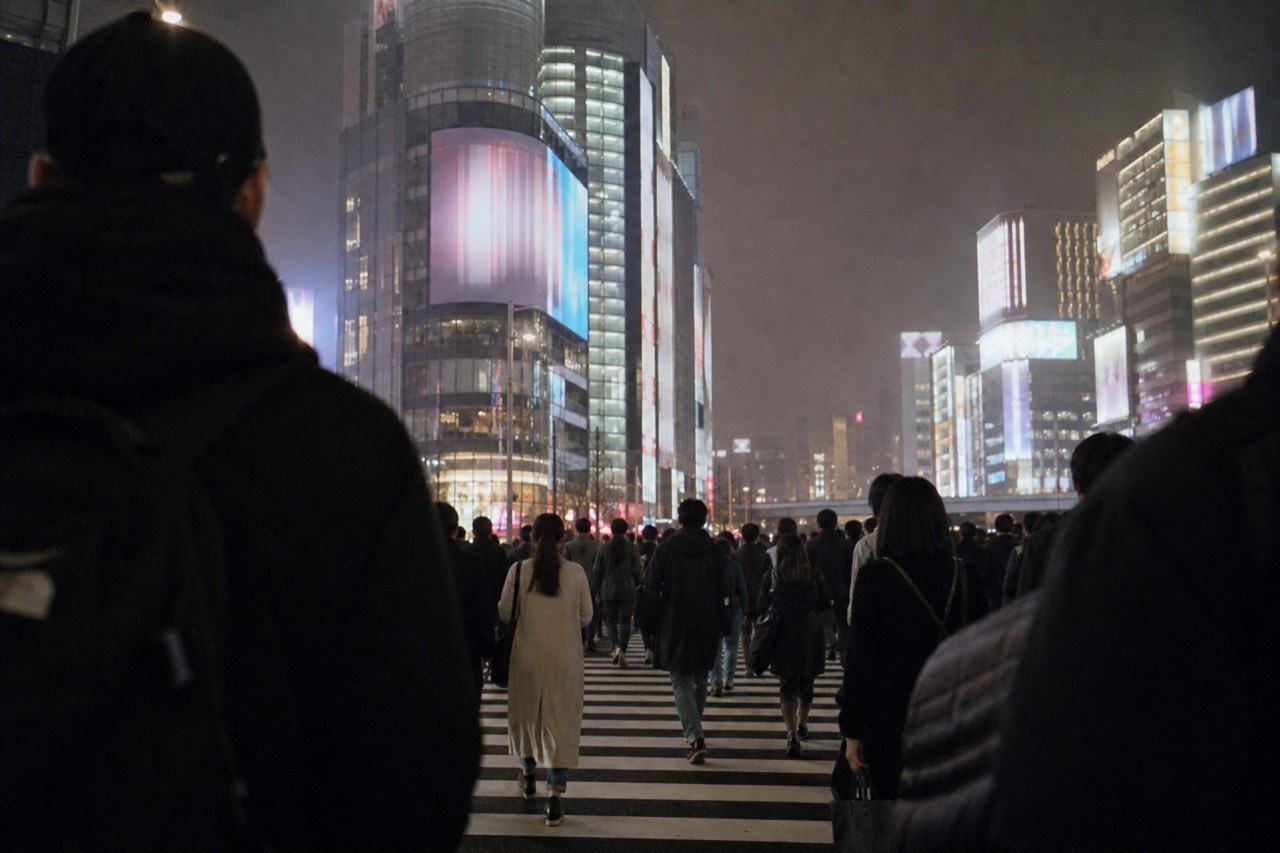
Stand at the Hachiko corner on a Friday evening and count the light cycles. Every two minutes or so the traffic stops, the pedestrian signals all turn green together, and a mass of people steps off five kerbs at once, including both diagonals. Twenty seconds later the road is empty again. Nobody collided. Nobody shouted. That sequence, repeated hundreds of times a day, is the entire reason Shibuya Crossing is on lists of things to see in a city that also contains a thousand-year-old shrine and the world's busiest train station.
It is a road junction. That is the funny part, and it is worth holding onto, because the fame is not really about the architecture or the neon or even the volume. It is about watching a system that should not work do exactly what it is supposed to, in front of you, on repeat.
Three Thousand People, One Green
The crossing is worth one pass on foot and one from 229 metres; the guided version folds both with the statue's story. Check your evening before the slots thin.
How many people actually cross at once?
Up to about 3,000 on a single green light at peak, with the average cycle commonly estimated between 1,000 and 2,500. A 2014 flow survey by the local redevelopment association measured roughly 260,000 crossings on weekdays and about 390,000 on non-working days, and no newer official count has replaced it.
Those numbers get inflated online constantly, so be careful with what you read. Figures in the millions usually refer to total station passenger movements or to counts of crossings rather than of individual people, and they are far less consistently sourced than the 2014 survey. The reliable version is unremarkable enough to be believable: a quarter of a million crossings on an ordinary weekday, half again as many at the weekend.
The density is what makes it visual rather than the daily total. Three thousand people occupying an intersection for twenty seconds produces an image no photograph of a busy street ever produces, because the crowd is not moving along a corridor. It is moving through itself. The reference record on the crossing collects the survey figures and the timing detail if you want the sources.
Which films and shows made it famous?
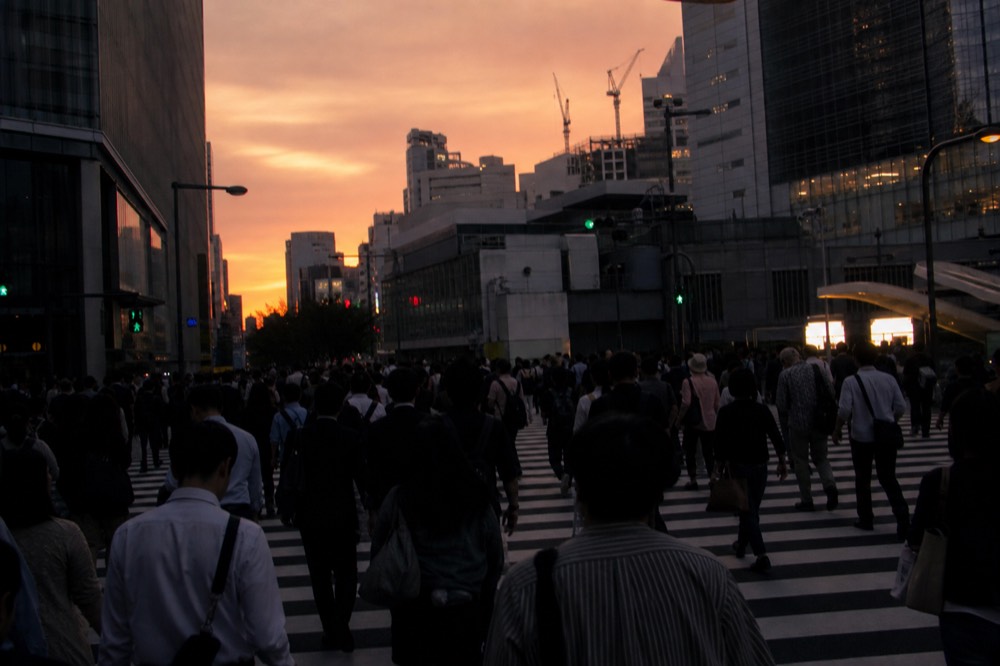
Lost in Translation, released in 2003, is the film that put the crossing in front of a global audience, and it has appeared since in action sequences, music videos, anime backgrounds, documentaries and countless news broadcasts about Tokyo. Live webcams pointed at it run continuously, which keeps the image in circulation year-round.
The pattern is self-reinforcing rather than accidental. A location that is instantly legible in a single wide shot, that carries motion, scale and a sense of place in two seconds of screen time, is enormously useful to a director who needs to say "Tokyo" without a caption. Once a few productions used it, it became shorthand, and shorthand is what a landmark actually is.
Television and streaming did the rest, along with the webcams. There has been a live view of this intersection online for years, which means people who have never been to Japan have watched the light cycle. Arriving in person to find that it looks exactly like the stream, only louder and wetter, is a strange and slightly delightful experience, and it explains why so many visitors film it themselves within thirty seconds of arriving.
The neighbouring landmark helps too. The Hachiko statue sits thirty seconds from the kerb, the station exit is named after it, and the dog's story of waiting nearly ten years is known well beyond Japan. A famous intersection with a famous monument attached is a stronger draw than either alone, which is why almost every walking route through this district connects the two. You can see how the guided version is priced if you would rather have the history told as you walk it.
Why does the scramble actually work?
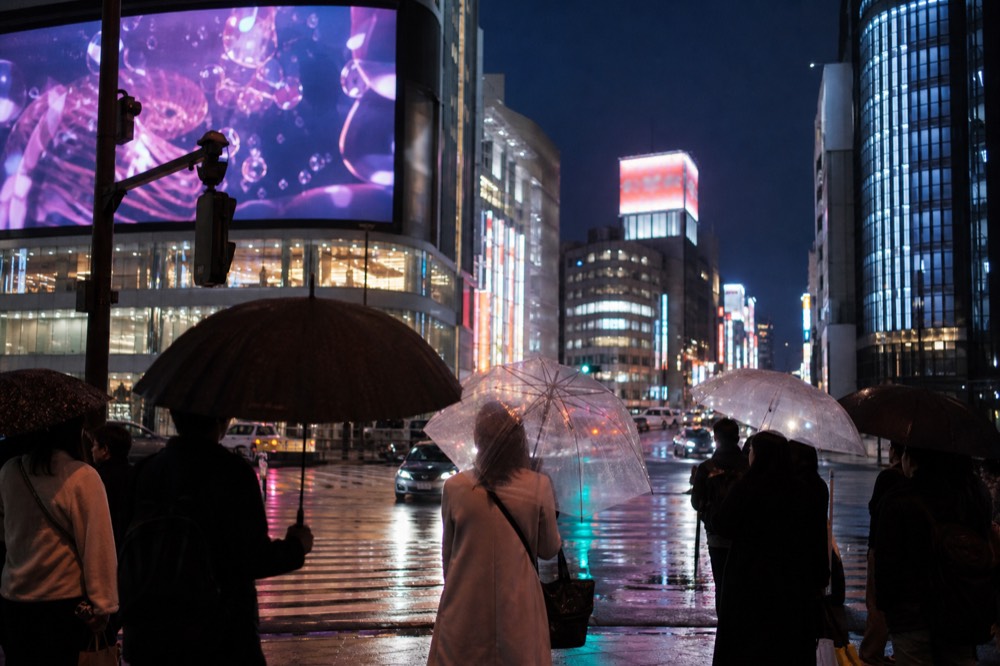
Because it is a full pedestrian scramble: every vehicle signal goes red at the same moment, every pedestrian signal goes green, and both diagonals open. Nobody is negotiating with traffic, so the crowd can spread across the entire road surface, including the middle, instead of queueing along two narrow marked lanes.
Ordinary crossings force pedestrians into strips at the edges of a junction while cars still turn through them. The scramble removes the conflict entirely for twenty seconds, which turns a road into a plaza. Five approaches feed it, so the flows arrive from many angles rather than head on, and people self-sort into loose diagonal streams within a step or two of leaving the kerb.
Watch closely and you can see individuals making micro-adjustments constantly, shifting a shoulder, slowing half a pace, choosing a gap three metres ahead. Tokyo's walking culture helps: people keep a consistent pace, do not stop abruptly in flow, and give way without eye contact. Drop three thousand people who all do that into a wide open square and you get something that looks choreographed and is not. It is worth standing still in the middle for one cycle to feel it happen around you, which is the first thing I suggest to anyone I take through the district on foot.
How should you actually experience it?
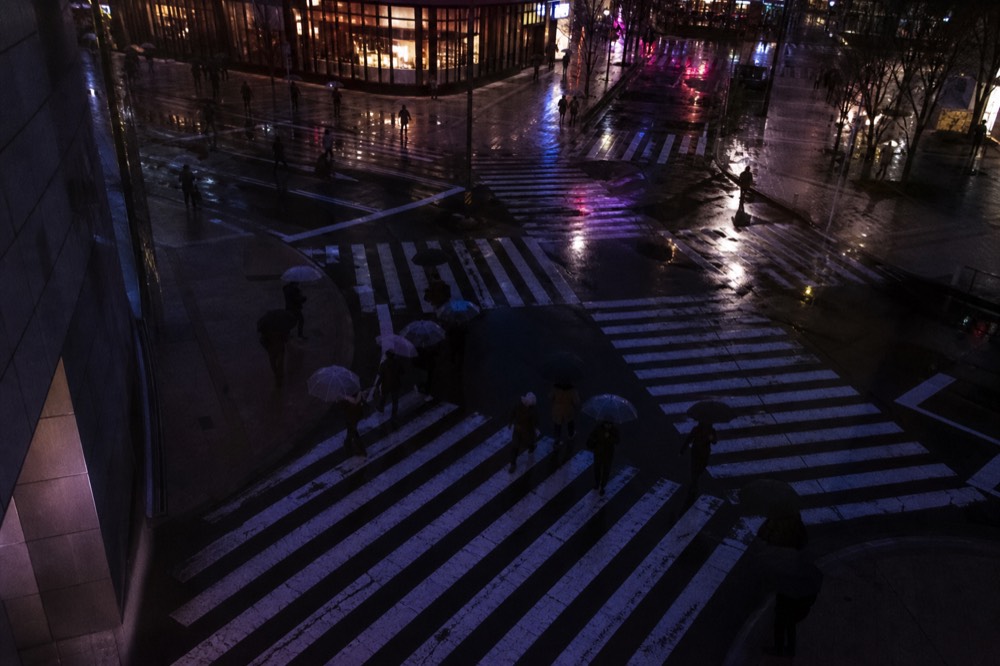
In three passes, in this order: cross it on foot at least twice, watch it from a low window or rooftop at roughly the same level as the crowd, and then see it from directly above at 229 m. Each one shows you something the other two cannot, and the sequence matters more than the individual stops.
Crossing it first fixes the scale. From inside the crowd you register the noise, the screens overhead, the twenty-second transit and the fact that nobody is touching you. Then take a low viewpoint. Mag's Park on the Magnet building roof has been the standard cheap elevated option for years, and window seats at the Tsutaya building café cost the price of a drink and a long wait. From two or three floors up, faces and umbrellas are still readable and the convergence is the picture. An independent roundup of crossing viewpoints tracks which are currently open.
The rooftop is the last pass and the one that reframes everything. From the top of Shibuya Scramble Square the intersection becomes a pale X in a circuit board, with the station tracks running off it and the city stretching to the mountains. You lose the people and gain the system. It is a different photograph and a different idea, and it is why I always run the ground level first. If you want that ending on a specific evening, check the current dates and price, since sunset slots go quickly. The full technical version of shooting it from up there is in the rooftop photography guide.
| Way to see it | Height | Cost | What you get | The catch |
|---|---|---|---|---|
| Street level, Hachiko side | Ground | Free | Inside the crowd, noise and scale | You are in the picture, not above it |
| Mag's Park rooftop | About 8 floors | Free or a small charge | Elevated but close, crowd still readable | Small deck, busy at peak hours |
| Starbucks window, Tsutaya building | 2nd floor | The price of a drink | The classic eye-level convergence shot | No reservations, long waits for a window seat |
| SHIBUYA SKY rooftop | 229 m, open air | 2,700 yen before 15:00, 3,400 yen from 15:00 | The crossing as a pattern, the whole city behind | Timed entry, sells out, no bags or tripods |
The building that gives you the top-down view has its own reasons for being worth a visit, set out in what Shibuya Scramble Square is known for, and the official visitor detail for the deck sits on Tokyo's tourism page for it. If you would rather have the whole sequence walked with you, the guided options for the district all include the crossing, and Shibuya Sky Tickets covers the last pass on its own.
Is Shibuya Crossing the busiest crossing in the world?
It is very widely described as the busiest, and on the available measurements that holds up: roughly 260,000 crossings on a weekday and about 390,000 on non-working days, with peaks of up to 3,000 people on a single green light. No competing intersection publishes numbers on that scale, though the last official Shibuya survey dates to 2014.
What time is Shibuya Crossing busiest?
The evening commuter peak on weekdays and through the afternoon and evening at weekends. If you want the crowd, come after 18:00. If you want a clear photograph of the intersection itself, come before about 08:00, when the light cycles run with only a handful of people on them and the whole junction is legible.
Do you need a ticket to see Shibuya Crossing?
No. The crossing is a public street and costs nothing to walk. Tickets only come into it if you want a view from above: the rooftop deck on Shibuya Scramble Square charges 2,700 yen before 15:00 and 3,400 yen from 15:00 online, while the low viewpoints cost either nothing or the price of a coffee.